
Key Takeaways
- People do not necessarily object to AI in advertising. The bigger question is whether an ad feels credible, relevant and worth their attention.
- AI can make brainstorming more efficient, but having a longer list of ideas does not necessarily lead to a stronger campaign.
- A detail from a customer conversation can be a better creative starting point than another trending format.
- AI can help creators plan and edit. Their personal experiences, though, should come from them, not from a generated script.
- The most useful approach is to let AI handle parts of the process while people make the decisions that shape the message.
Is AI Changing What Creativity Means in Social Media Marketing?
Memorable social media content often has something specific to say. It may answer a question customers regularly ask, introduce an unfamiliar perspective or tell a story that feels relevant to their lives.
A polished visual can help attract attention, but it may not be enough to make the message memorable. As more content is produced, brands have to think more carefully about what makes their ideas different.
AI makes it easier to draft captions, plan videos and explore visual ideas in minutes. For a small marketing team, that can be a real advantage.
As more brands use the same tools, producing content quickly is becoming less of a differentiator. The time saved can instead be spent understanding customers and refining ideas that speak to them.
AI is useful for exploring possible approaches. Marketers still need to choose the ones that reflect their brand and answer a genuine audience need.
Short on time? Here’s a quick video breakdown of how AI is changing social media creativity, why content can start to feel repetitive, and how marketers can use AI more thoughtfully. Watch the highlights, then read on for the full insights!
Why Are Audiences Pushing Back Against AI-Generated Content?
Consider a skincare video featuring a dramatic before-and-after transformation. If the result was generated with AI but presented as genuine, viewers could reasonably feel misled.
The concern in this situation is not the technology itself, but the difference between what the advertisement suggests and what the product has actually achieved.
A clearly fictional campaign is different. Brands can use AI to create imaginary settings or playful visuals without implying that those scenes happened in real life.
The distinction becomes important when AI-generated imagery is used to suggest genuine product results, customer reviews or personal experiences.
The expectations set by a campaign matter too. This is particularly clear when a brand makes craftsmanship or human creativity part of its message.
When Craftsmanship Becomes Part of the Brand Story: Dior
Dior’s animated Christmas film, “Christian Dior’s Night in Colour,” offers another perspective. Presented as a celebration of hand-drawn craftsmanship, the campaign sparked debate after viewers noticed unusual animation details, including distorted lettering and hands that appeared to have extra fingers. Cartoon Brew shared examples of the frames circulated online as alleged signs of AI use.

The director and producer denied using generative AI to create the animation, although they acknowledged using automated interpolation for a small part of the process. Interpolation is not necessarily the same as generative AI, and the disputed frames alone do not establish how they were made.
Because the film emphasised hand-drawn craftsmanship, questions about its production attracted attention alongside the story itself.
For marketers, this shows why the way a campaign is made can matter to audiences, especially when the production process is part of what the brand celebrates.
That does not rule out the use of AI in creative work. It means brands should be thoughtful about how their production choices fit the story they are telling.
Is AI Making Marketers More Creative or Just Faster?
AI can be particularly useful at the beginning of content planning, when teams need to explore several directions within a limited timeframe.
It can organise recurring customer questions, suggest video structures and help adapt messaging for different platforms. These tasks create more room for the team to develop and evaluate ideas.
The benefit is not simply a fuller content calendar. It is having more time to develop ideas that customers may actually find useful or worth sharing.
The Creative Challenge: When More Ideas Start Looking the Same
AI tools can generate social media concepts quickly, although broad prompts often produce familiar formats such as morning routines, café tours and recommendation videos.
These formats can still work, but without a clear angle, a café tour or morning routine may look much like dozens of similar posts.
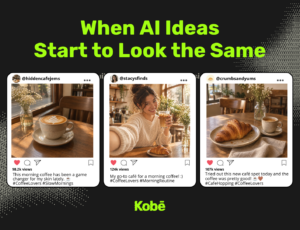
*Illustrative examples created to demonstrate similarities in social media content ideas.
For example, three cafés in Singapore could use AI to develop TikTok concepts and receive variations of the same ideas: a morning coffee routine, a café recommendation and a video introducing a new location.
Although each idea could attract attention, none necessarily explains what makes the featured café worth visiting over another.
A more distinctive approach would begin with an observation unique to the business, such as customers repeatedly asking about a signature drink or returning for a particular part of the café experience.
Including those details in the prompt can help marketers develop ideas that show what makes a café different, rather than relying on formats that could suit almost any brand.
How Can Marketers Use AI Without Losing Creativity?
For a new café for example, the starting point could be a question that customers frequently ask rather than a general request for viral TikTok ideas.
If customers are curious about the café’s pandan cold brew, for example, AI could help the team explore ways to explain behind the scenes of the ingredients used or show how the drink is prepared.
Possible concepts include a behind-the-scenes video, a short explanation from the barista or a creator-led tasting. The value comes from choosing a format that fits the café’s actual experience.
Marketers would then need to assess which idea is accurate, relevant to their audience and likely to communicate the café’s strengths effectively.
The table below shows how a small change in the brief can lead to more focused ideas.
*Illustrative example showing how different AI prompts may influence content ideas. Outputs shown are examples, not actual AI test results.
| Generic AI Prompt | Insight-Led AI Prompt |
| “Give me 5 TikTok ideas to promote my café.” | Our new café in Singapore gets frequent questions about what makes our pandan cold brew different. Suggest five TikTok ideas showing the drink and inviting people to try it. Avoid inventing reviews or customer reactions. |
| Focus: Promoting the café in general. | Focus: Answering a specific question potential customers have about the café. |
| Possible output: Coffee-making videos, café tours and aesthetic drink shots. | Possible output: A behind-the-scenes look at the signature drink, a staff explanation and a first-look café visit. |
A more detailed prompt will not guarantee a distinctive idea, but it gives marketers a clearer starting point for developing one.
When Does AI-Assisted Influencer Content Stop Feeling Genuine?
Creator reviews can offer details that are difficult to capture in a product description, such as a food portion that differs from expectations, the waiting time at a popular stall or an item the creator would order again.
These observations matter because they come from an actual experience. A well-written script cannot, by itself, provide the same first-hand perspective.
The growing use of AI presenters therefore raises an important distinction between communicating information and presenting a personal recommendation.
GastroBeats: Comparing an AI Presenter and a Creator’s Food Review
Two TikTok posts about GastroBeats Singapore 2026 show how an AI presenter and a creator can cover the same event in different ways. One introduces the event’s offerings, while the other approaches it as a personal food review.
In the first video, AI creator Maya (@aiavatarmaya) introduces halal food choices, participating vendors and activities at GastroBeats. The post is labelled as AI-generated media.
The AI-presenter format can be useful for introducing an event and its food options. It does not, however, provide a first-hand account of what a visitor actually tried.
In the second video, TikTok creator Rayyan (@rayyanroulette) asks whether GastroBeats is worth visiting. The caption gives a positive verdict on the food tried, making it a personal review.
For viewers deciding whether to visit, a creator’s assessment can answer a different question: what was the experience like, beyond the event information?
The two formats serve different purposes. Brands can use AI presenters to explain what is available and creator-led reviews when a genuine first-hand perspective is important.
These examples are not evidence that one format performs better or attracts more trust. Their value is in showing how the right approach depends on what viewers want to learn.
For a campaign, that distinction helps determine whether the content should inform, demonstrate or offer a personal recommendation.
Why This Matters in Singapore and Southeast Asia
As AI-generated content becomes more common, consumer perceptions are becoming increasingly important for brands across Singapore and Southeast Asia.
According to DoubleVerify’s 2026 findings, reported by Marketing-Interactive, 41% of Southeast Asian consumers said low-quality AI-generated advertisements would negatively affect their perception of a brand. In Singapore, this figure was slightly higher at 47%, while 45% responded positively to professionally produced AI advertisements.
However, quality goes beyond polished visuals. In March 2026, Marketing-Interactive reported that Singapore’s Advertising Standards Authority (ASAS) received complaints about a telemedicine advertisement featuring an AI-generated character delivering a first-person testimonial, which appeared to represent a real person’s experience.
These examples highlight that consumers are not necessarily against AI-generated advertising. For marketers, the priority should be creating content that is well-executed, accurate and transparent about what is real, particularly when personal experiences or recommendations are involved.
When Should Marketers Use AI and When Should They Think Twice?
Whether AI is useful depends on the job the content needs to do. Drafting an event explainer is different from sharing a personal review.
AI can help plan both, but claims about a real experience should still come from someone who has had that experience.
Five Practical Ways Brands Can Use AI Without Losing Creative Value
- Begin with something your audience has actually said. Customer questions, comments and feedback provide a stronger starting point than asking AI for ideas that might go viral. Use AI to explore different ways of addressing those interests.
- Make sure the content reflects the real product. AI can help sketch out a skincare ad or plan the shots, but any claimed results should come from evidence rather than generated before-and-after visuals.
- Give creators room to sound like themselves. AI might help organise a brief, edit subtitles or draft a caption. A creator’s opinions and experiences should still come through in their own words.
- Review the details that matter locally. A caption written for one market may not sound natural in another. Have someone familiar with the Singapore or wider Southeast Asian audience check the language, references and tone before publishing.
- Pay attention to how people respond, not just how much you produce. More posts may save time, but comments, saves, shares and campaign outcomes can tell you whether the ideas are actually connecting with viewers.
A Final Check Before Your AI-Assisted Content Goes Live
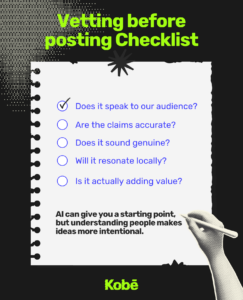
The checklist below is a useful last review before publishing. It brings together five questions worth discussing with the team, from what audiences might believe about the content to whether the final message still feels true to the brand.
A quick review at this stage can catch details that are easy to miss during production, especially when several people or tools have contributed to the same piece of content.
AI-generated advertising is not automatically misleading. ASAS has emphasised that the usual standards for truthful advertising still apply, regardless of which tools were used. A disclosure may explain how content was made, but it does not make an inaccurate claim acceptable.
Conclusion: Is AI Really a Threat to Creativity?
AI gives marketers more freedom to test an idea before committing to full production. That is especially useful when a team needs to explore different directions within a short timeframe.
The benefit becomes less meaningful if that time is spent producing several versions of the same familiar concept.
For example, AI might help a café brainstorm video concepts or give a creator a first script outline. What makes the finished piece worthwhile is the detail the team chooses to develop, not the number of drafts it can produce.
A strong result still depends on understanding what customers care about and recognising which ideas have something useful to offer.
AI works best as part of the creative process, helping with routine work while marketers and creators spend more attention on the choices that shape the final story.
Frequently Asked Questions
1. Is AI-generated content bad for social media marketing?
No. Clearly fictional AI visuals can be creative and entertaining. Problems arise when content misleads viewers about real product results, events or personal experiences.
2. How can brands use AI without making their content look generic?
Start with a customer question or a detail that makes the brand different. Ask AI for several approaches, then choose and improve the one that suits your audience.
3. Should brands disclose AI-generated social media content?
Brands should follow applicable laws and platform requirements, and clearly explain AI involvement when audiences could otherwise misunderstand whether a scene, person or testimonial is real. Disclosure should not be used to excuse misleading claims.
4. Will AI replace influencers in marketing campaigns?
Not necessarily. AI can help produce and edit content, but a generated presenter cannot replace a first-hand experience when that is what the audience needs.
5. How can marketers tell whether AI is helping them create better content?
Do not judge it only by how quickly the team can post. Look at whether the content is relevant, accurate and distinctive, and whether audiences respond in ways that support campaign goals.